
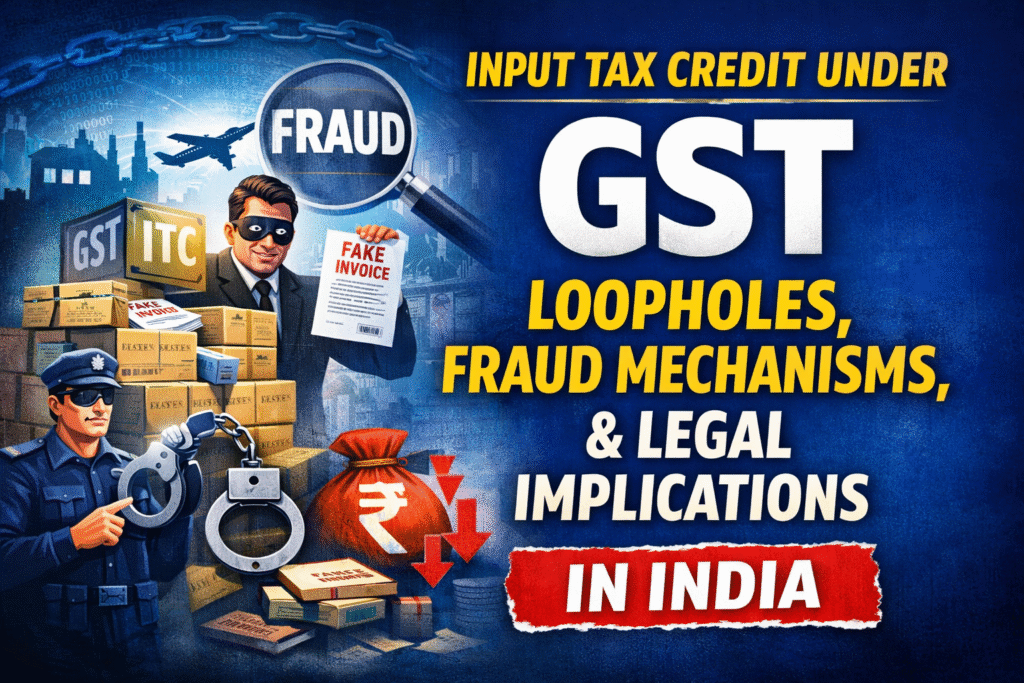
The Goods and Services Tax (GST) was introduced in India with the objective of creating a unified indirect tax regime and eliminating the cascading effect of taxes. At the core of this system lies the concept of Input Tax Credit (ITC), which allows businesses to claim credit for the tax paid on inputs and set it off against their output tax liability. While ITC ensures tax neutrality and promotes ease of doing business, it has simultaneously emerged as the most vulnerable and exploited component of the GST framework. Over the years, numerous instances of fraudulent ITC claims—particularly involving small, shell, or fictitious entities—have highlighted systemic weaknesses that continue to challenge enforcement authorities.
Legal Framework Governing ITC
The eligibility and conditions for claiming ITC are primarily governed by Section 16 of the Central Goods and Services Tax Act, 2017. A registered person is entitled to claim ITC subject to fulfillment of certain conditions, including possession of a valid tax invoice, receipt of goods or services, actual payment of tax to the government, and filing of prescribed returns. Additional provisions such as Sections 17, 41, and 43, along with relevant rules, further regulate apportionment, restrictions, and procedural compliance.
Despite this seemingly robust statutory framework, the practical enforcement of these conditions—particularly the verification of actual supply and tax payment—remains a significant challenge. This gap between legal requirements and ground-level implementation has created fertile ground for misuse.
Invoice-Based Credit System: The Core Structural Vulnerability
One of the most critical weaknesses of the GST regime lies in its reliance on an invoice-based credit system. In theory, ITC should be linked to actual supply and consumption of goods or services. However, in practice, the presence of a valid tax invoice often becomes the primary basis for availing credit.
This creates a situation where documentation takes precedence over economic substance. Fraudsters exploit this by generating invoices without any corresponding movement of goods or provision of services. Since initial scrutiny is largely system-driven and document-based, such transactions may go undetected for a considerable period, allowing wrongful ITC claims to be utilized or even refunded.
Fake Invoicing and Bill Trading: The Most Common Fraud Model
Fake invoicing, commonly referred to as “bill trading,” is one of the most prevalent forms of GST fraud. In this model, entities issue invoices without actual supply of goods or services, enabling recipients to claim ITC fraudulently.
Typically, a fake supplier generates invoices charging GST and passes on the credit to another entity. The recipient avails ITC based on these invoices, while the supplier either does not deposit the tax or becomes non-compliant and eventually untraceable. This results in a direct loss to government revenue, as credit is availed without any corresponding tax inflow.
Such rackets often operate through organized networks involving multiple entities, dummy directors, and fabricated documentation, making detection and prosecution complex.
Role of Shell Entities and Fake Registrations
The ease of obtaining GST registration, particularly during the initial years of GST implementation, facilitated the proliferation of shell entities. These entities are typically created with no intention of conducting genuine business activities.
They exist solely to issue invoices, pass on ITC, and facilitate fraudulent transactions. Often, these firms operate for a short duration, generate significant invoice volumes, and then disappear without fulfilling tax obligations. The use of fake addresses, forged documents, and proxy individuals further complicates enforcement efforts.
Such “fly-by-night operators” form the backbone of many large-scale ITC frauds.
Circular Trading and Layered Transactions
Circular trading is another sophisticated mechanism used to exploit the ITC system. In this arrangement, multiple entities engage in a series of transactions among themselves, creating the appearance of genuine trade without any actual movement of goods.
For example, goods may be invoiced from Entity A to B, then B to C, C to D, and eventually back to A. In some cases, no goods move at all; only invoices circulate. This layering of transactions inflates turnover figures, legitimizes fake ITC, and obscures the origin of fraudulent credits.
The complexity of such networks makes it difficult for authorities to trace the initial point of fraud, especially when transactions are spread across multiple jurisdictions.
Exploitation of Export and Refund Mechanisms
Under GST, exports are treated as zero-rated supplies, allowing exporters to claim refunds of accumulated ITC. While this provision is intended to promote exports, it has also been misused by fraudulent operators.
In many cases, entities fabricate export transactions or inflate the value of exports to claim excessive refunds. Since refunds are processed based on documentation, including shipping bills and invoices, the absence of rigorous physical verification enables such frauds. This results in direct outflow of government funds based on fictitious or exaggerated claims.
Breakdown of Invoice Matching Mechanism
The GST framework originally envisaged a robust invoice matching system involving GSTR-1, GSTR-2, and GSTR-3 returns. This system was designed to ensure that ITC claims by recipients matched the tax declarations made by suppliers.
However, due to practical and technical challenges, the matching mechanism was not fully implemented, and reliance shifted to self-declared returns such as GSTR-3B. This significantly weakened the verification process, as ITC could be claimed without real-time reconciliation.
Although tools like GSTR-2A and GSTR-2B have been introduced to improve transparency, they do not completely eliminate the risk of fraudulent claims, particularly where suppliers default after issuing invoices.
Time Lag Between ITC Claim and Verification
A critical vulnerability in the system is the time gap between the availment of ITC and its verification by authorities. Taxpayers can claim and utilize ITC immediately upon filing returns, while verification and scrutiny may occur months later.
Fraudsters exploit this time lag to:
- Avail and utilize credit
- Withdraw funds through refunds
- Shut down operations before detection
By the time authorities initiate action, the entities involved may no longer be traceable, making recovery difficult.
ITC Laundering Through Multiple Layers
To further complicate detection, fraudulent ITC is often routed through multiple intermediary entities before reaching a final beneficiary. This process, often referred to as ITC laundering, creates a chain of transactions that appear legitimate on the surface.
As the credit passes through several layers, it becomes increasingly difficult to identify the original source of fraud. In some cases, even genuine businesses unknowingly become part of such chains, exposing them to legal consequences, including reversal of ITC, penalties, and litigation.
Manipulation of E-Way Bills and Logistics Documentation
The e-way bill system was introduced to track the movement of goods and prevent tax evasion. However, fraudsters have developed methods to manipulate this system as well.
Common practices include generating e-way bills without actual transportation of goods, reusing vehicle numbers, and creating fictitious logistics records. These tactics provide a semblance of legitimacy to transactions that do not involve any real supply.
High Transaction Volume and Detection Challenges
The GST system processes an enormous volume of transactions daily, making comprehensive real-time verification difficult. Fraudsters exploit this by breaking transactions into smaller amounts and distributing them across multiple entities to avoid detection.
This high-volume, low-visibility environment allows fraudulent activities to continue undetected for extended periods, especially when they do not trigger immediate risk indicators.
Involvement of Small Businesses and Intermediaries
Small businesses and newly registered entities are often used as vehicles for ITC fraud due to lower scrutiny and limited compliance oversight. In many cases, specialized intermediaries or “entry operators” facilitate the creation of fake firms, manage invoice generation, and orchestrate the flow of ITC across networks.
These intermediaries play a critical role in sustaining large-scale fraud operations by providing technical expertise and coordinating multiple entities.
Government Measures and Regulatory Response
Recognizing the scale of ITC fraud, the government has introduced several measures to strengthen compliance and enforcement. These include restrictions on ITC claims based on GSTR-2B, Aadhaar-based authentication for registration, and the power to block suspicious ITC under Rule 86A.
Additionally, authorities have increased the use of data analytics and artificial intelligence to identify abnormal transaction patterns, circular trading, and mismatches. Physical verification of business premises and stricter scrutiny of high-risk taxpayers have also been implemented.
Provisions for arrest and prosecution under Section 132 of the CGST Act have been actively invoked in serious cases, signaling a shift toward stricter enforcement.
Judicial Approach and Evolving Jurisprudence
Courts in India have increasingly emphasized the need for due diligence by taxpayers while claiming ITC. Judicial pronouncements suggest that ITC cannot be claimed solely on the basis of invoices without verifying the authenticity and compliance status of suppliers.
At the same time, courts have also recognized the challenges faced by bona fide purchasers, leading to an evolving jurisprudence on the extent of responsibility that can be imposed on recipients. This remains a developing area of law, with significant implications for businesses.
Core Issue: Documentation vs Economic Reality
The fundamental issue underlying ITC fraud is the disconnect between documentary compliance and actual economic activity. The system’s reliance on invoices and self-declaration, combined with delayed verification, allows fraudulent transactions to be presented as legitimate.
Until the GST framework achieves real-time validation of supply, tax payment, and credit flow, the risk of ITC-related fraud will persist despite regulatory efforts.
Conclusion
While the Input Tax Credit mechanism is essential for the efficient functioning of GST, its structural vulnerabilities have made it a focal point for tax evasion and fraud. The combination of invoice-based crediting, ease of entity creation, delayed verification, and high transaction volumes has enabled sophisticated fraud schemes involving fake invoicing, circular trading, and wrongful refund claims.
The government’s ongoing efforts to tighten compliance through technological interventions, stricter regulations, and enforcement actions are steps in the right direction. However, addressing the issue comprehensively will require not only systemic improvements but also increased awareness and diligence among taxpayers.
Ultimately, the integrity of the ITC system depends on bridging the gap between documentation and actual economic substance ensuring that tax credits reflect genuine business transactions rather than fabricated paper trails.
